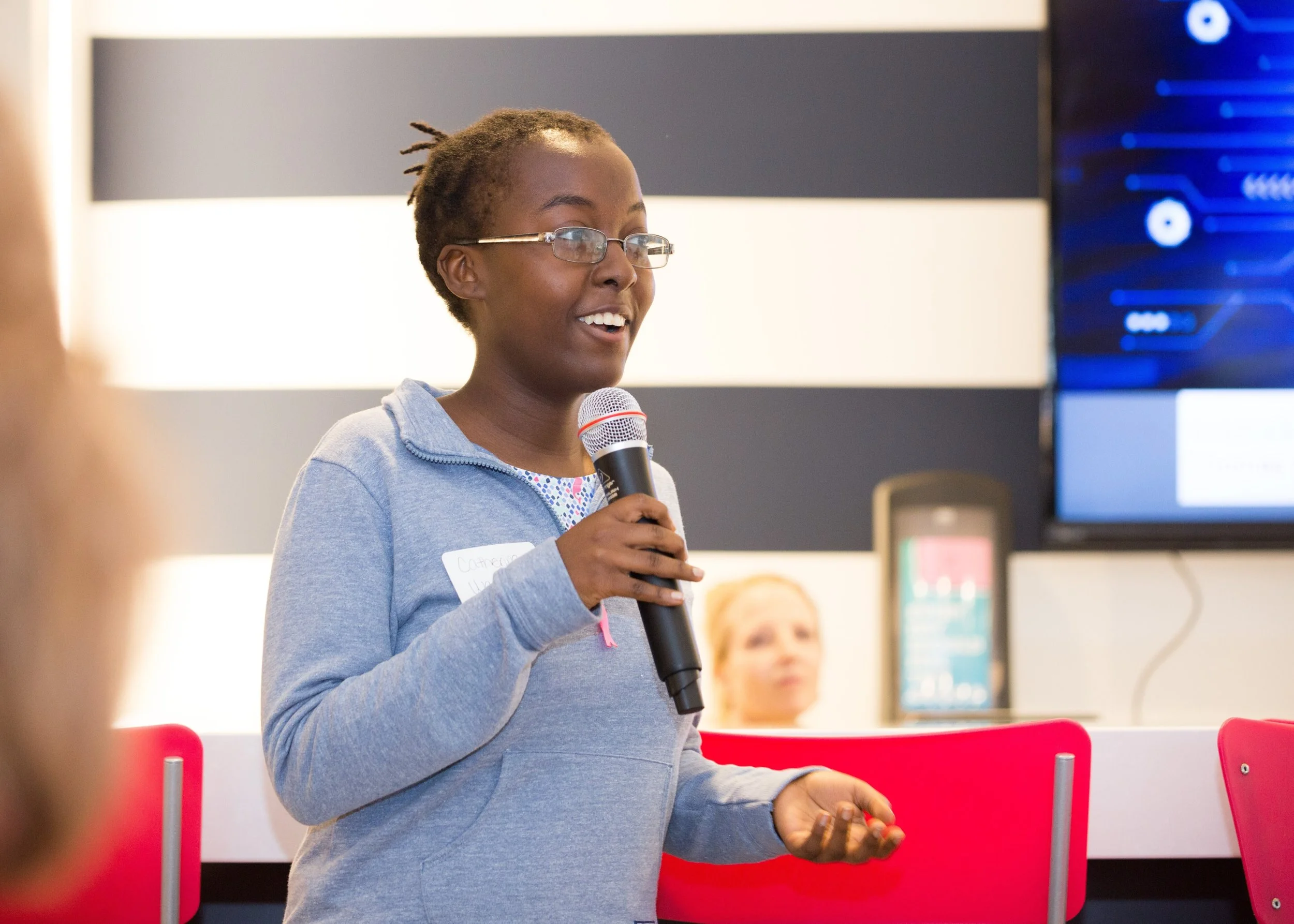
Girls With Impact

There is a quiet revolution burgeoning among young American women who range in age from high schoolers to college level students, and it is the brainchild of the highly talented Jennifer Openshaw. A businesswoman who developed her chops in an array of hard-driving sectors of global business—including Wall Street, Silicon Valley, Television, and “Main Street”—she well knows what it takes to (first) survive and then to thrive in the maelstrom of high-powered capitalism.
Since the start of the decade of the nineties, there has been a significant—maybe more accurately described as monumental—growth in highly-educated young women entering the workforce as professionals. Today, one can look at a host of industries and recognize the gains that women have made across a broad spectrum of the economy.
Unlike half a century ago—when I was at the bottom of the ladder in the workforce with only a dream of much more—young women today comprise more than fifty percent of college attendees, of medical school graduates, and of law school graduates. Even in the male dominated fields of finance and investment, women make up more than 40% of graduate business school attendees. Increasingly, they enter the fields of finance, law, medicine, technology, entertainment and on and on with skills that match their male counterparts. That has resulted, particularly in the last decade or so, in noteworthy strides made by women in C-suite participation in American companies, where they now hold nearly 30% of positions, in contrast to about 17% only ten years ago.
Over the last decade, Jennifer Openshaw put her own mark on the pathway for working women. After years of listening to business leaders bemoan the fact that there weren’t enough young women leaders in the workplace, she took matters into her own hands and started an organization she called Girls With Impact (GWI). Convinced that if young women were trained earlier with skills that were in demand—critical thinking, problem solving, collaboration, agility, financial literacy, professionalism, communication, drive, adaptability, and perhaps above all CONFIDENCE—they would enter the workforce better equipped to display the leadership skills that would lead to enhanced opportunities and a career that could be far more rewarding.
The organization’s mission was, and is today, to engage with girls in low-to-moderate income families. Jennifer knows the ropes in that arena. Raised by a single mother from the age of five, by the time she was seven years old, she was taking on the responsibility of helping care for your two younger brothers while her mother worked two full-time jobs as a waitress. At the age of fourteen, she herself was working—as a maid in a motel. She never stopped working, funding her way through UCLA undergraduate and graduate school before striking out as a confident businesswoman.
Jennifer spawned Girls With Impact with a pilot afterschool program, in collaboration with the local high school. She dubbed the experiment the “GWI Innovation Academy” and invited five girls, between the ages of 15 and 17 to attend. It was a ten-week program in which each girl brought a project idea, ranging from nonprofit to social impact to for-profit. Jennifer’s memories from that embryonic start are vivid. She spoke of one student, who, three weeks into the program, surprised her parents when she told them, “I feel powerful.” Talk about confidence! The father of another girl told Jennifer, “This is the early business conditioning my daughter needs.”
That early experiment led to what is today a business school built for young women who range in age from 14 to 24, i.e., high school and beyond. The basic program takes place over a ten-week period, with small classes of no more than 25 students led by a business instructor. The live classes and remote attendance allow the program to reach girls across the country, often who live in rural areas, and even beyond the U.S. In the last couple of years, AI has incorporated into the program.
The ten-week sessions are held on a quarterly basis year-round, and at the end of each quarter, a formal hybrid graduation takes place. In less than a decade, the program has expanded to engage 300 professionals and mentors. This year alone, there will be a total of 140 classes engaging 3000 students in over 500 schools across the country.
At the beginning of the quarter, each girls creates a “passion project.” Over the subsequent weeks, as a class, they learn the fundamentals of business and hands-on problem solving—from competitor analysis and marketing to financial budgeting, to selling the project to an “investor,” i.e., the class of twenty-five and the teacher. The program is crafted to develop an entrepreneurial mindset. Upon graduation, each girl owns a business plan for a project of her own choosing. She’s earned a micro-credential and a unique way to differentiate herself. Importantly, she has also developed skills that are essential in the world of business—communication, problem solving, and marketing. In the process of becoming entrepreneurs, they have developed confidence, capabilities and connections.
The program is growing, with as many as 30% of new students learning of the opportunity through social media. Today, approximately half the students are in high school and half are already enrolled in four-year or two-year colleges. Over the past nine years, approximately 20,000 students have gone through the program.
By 2030, Jennifer hopes to have graduated some 50,000 young women armed with the skills and confidence that will help propel them in their career dreams. I have every confidence that she will attain her lofty goal. www.girlswithimpact.org